 UK Test Prep guide
Famous British People in the Life in the UK Test: Scientists, Writers, Artists and Sportspeople
By Muhammad Shahid Khan · · 4 min read
Quick answer
The test often asks who did what. Key names include Isaac Newton (gravity), Charles Darwin (evolution), Alexander Fleming (penicillin), Tim Berners-Lee (the World Wide Web), Shakespeare, Jane Austen, Charles Dickens and Robert Burns, artists like Turner and Constable, leaders like Churchill and Thatcher, and sportspeople from Roger Bannister to Mo Farah.
UK Test PrepCitizenship, ILR & Visa Prep · Free on the App StoreDownload free →| Penicillin | Alexander Fleming, 1928 |
|---|---|
| Television | John Logie Baird |
| World Wide Web | Tim Berners-Lee |
| Structure of DNA | Francis Crick and James Watson, 1953 |
| Scotland’s national poet | Robert Burns |
| First four-minute mile | Sir Roger Bannister, 1954 |
People questions are some of the easiest marks in the test, if you have matched each name to the right achievement. They are also easy to mix up: who invented the television, and who invented the jet engine? Here are the people the handbook covers, grouped by field.
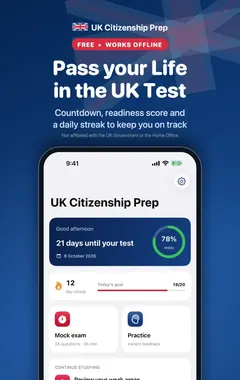
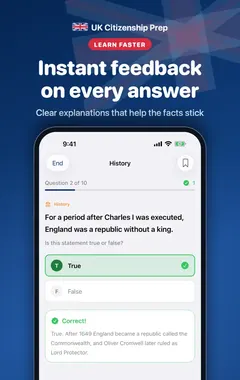
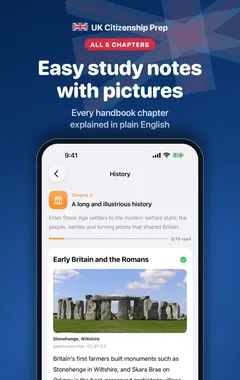
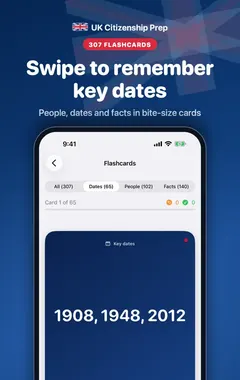
I build UK Test Prep, a free iPhone and iPad app for the Life in the UK test, and the screenshots in this guide come from it. If you want to test yourself as you read, get UK Test Prep on the App Store.
Scientists and inventors
| Person | Famous for |
|---|---|
| Isaac Newton | Gravity and the laws of motion; showed white light is made of colours |
| Charles Darwin | The theory of evolution, On the Origin of Species |
| Alexander Fleming | Discovered penicillin in 1928 |
| John Logie Baird | Developed television in the 1920s |
| Robert Watson-Watt | Radar |
| Frank Whittle | The jet engine |
| Christopher Cockerell | The hovercraft |
| Alan Turing | The Turing machine, a foundation of modern computing |
| Tim Berners-Lee | The World Wide Web |
| Francis Crick and James Watson | The structure of DNA, in 1953 |
| Ian Wilmut and Keith Campbell | Cloned Dolly the sheep in 1996 |
| Peter Mansfield | Co-inventor of the MRI scanner |
| Isambard Kingdom Brunel | Engineer of the Great Western Railway, tunnels, bridges and ships |
Writers and poets
- William Shakespeare (1564 to 1616): playwright of Romeo and Juliet, Hamlet and many more.
- Geoffrey Chaucer: The Canterbury Tales.
- Jane Austen: Pride and Prejudice and Sense and Sensibility.
- Charles Dickens: Oliver Twist and Great Expectations.
- Robert Burns: Scotland's national poet, who wrote Auld Lang Syne.
- Robert Louis Stevenson: Treasure Island.
- Sir Arthur Conan Doyle: the Sherlock Holmes stories.
- William Wordsworth: poet of nature; Rudyard Kipling: Nobel Prize in Literature in 1907; Dylan Thomas: Welsh poet.
- J.K. Rowling: the Harry Potter books.
Artists, composers and architects
- Painters: Thomas Gainsborough (portraits), John Constable (landscapes), J.M.W. Turner (landscapes, light) and David Hockney (pop art).
- Sculptor: Henry Moore.
- Composers: Henry Purcell; George Frederick Handel (Water Music, Messiah); Gustav Holst (The Planets); Sir Edward Elgar (Pomp and Circumstance Marches); Ralph Vaughan Williams; Benjamin Britten.
- Architects and garden designers: Sir Christopher Wren (St Paul's Cathedral); Robert Adam; Capability Brown (landscaped gardens); Gertrude Jekyll; Sir Edwin Lutyens.
Leaders and campaigners
- Sir Winston Churchill: Prime Minister during the Second World War.
- Clement Attlee: Prime Minister from 1945, when the welfare state was created.
- William Beveridge: the 1942 report that led to the welfare state.
- Aneurin (Nye) Bevan: Minister for Health who led the creation of the NHS.
- R. A. Butler: the 1944 Education Act.
- Margaret Thatcher: the first woman Prime Minister, from 1979.
- Emmeline Pankhurst: led the campaign for women's votes.
- Florence Nightingale: founder of modern nursing.
Sportspeople
- Sir Roger Bannister: first person to run a mile in under four minutes, in 1954.
- Bobby Moore: captain of the England team that won the 1966 World Cup.
- Sir Jackie Stewart: three-times Formula 1 world champion.
- Jayne Torvill and Christopher Dean: Olympic ice-dancing gold in 1984.
- Sir Steve Redgrave: gold medals in rowing at five consecutive Olympic Games.
- Baroness Tanni Grey-Thompson: 11 Paralympic gold medals and six London Marathon wins.
- Dame Kelly Holmes: two Olympic golds in 2004.
- Dame Ellen MacArthur: fastest solo sailing trip around the world, in 2004.
- Sir Chris Hoy: six Olympic cycling golds.
- David Weir: six Paralympic golds in wheelchair racing.
- Bradley Wiggins: first Briton to win the Tour de France, in 2012.
- Mo Farah: 5,000 m and 10,000 m Olympic golds in 2012.
- Jessica Ennis: heptathlon gold in 2012.
- Andy Murray: in 2012, the first British man to win a Grand Slam singles title since 1936.
- Ellie Simmonds: Paralympic swimming gold medals.
How do I remember who did what?
- Learn in pairs: name and achievement, never a name alone.
- Group by field, so inventors are not confused with writers.
- Watch for similar pairs: Baird (TV) and Watson-Watt (radar); Whittle (jet engine) and Cockerell (hovercraft); Constable and Turner (both landscape painters).
- Review flashcards daily for a week. See the hardest topics and the British history timeline.
How UK Test Prep helps
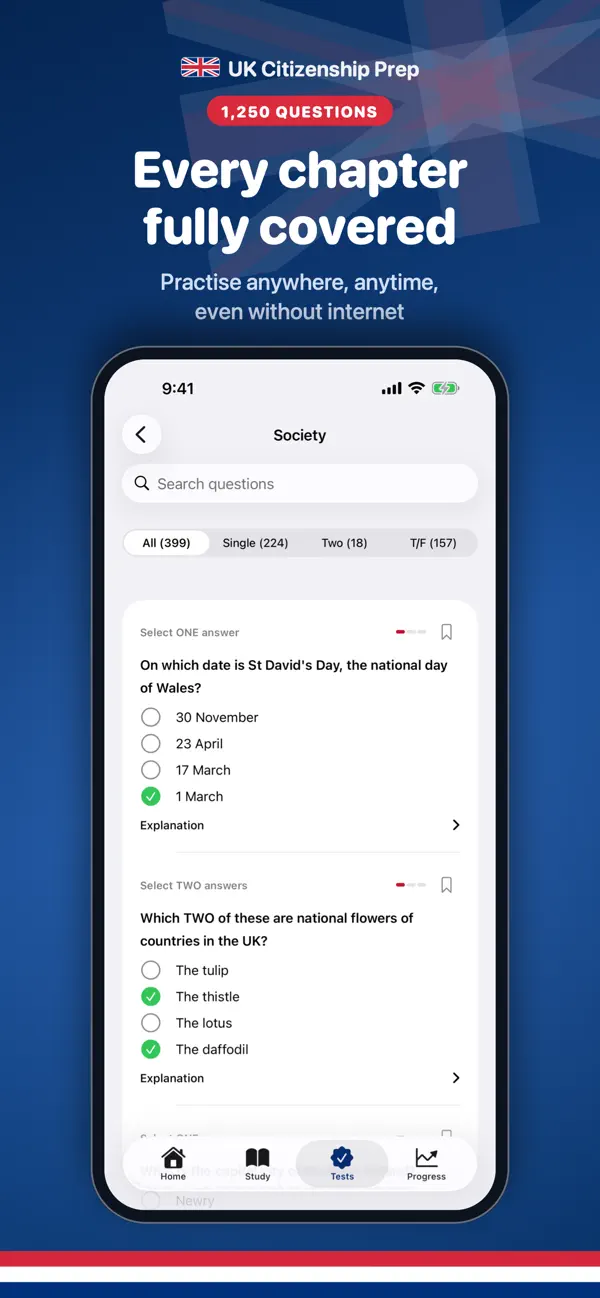
- 1,250 original practice questions across all five handbook chapters, each with an explanation.
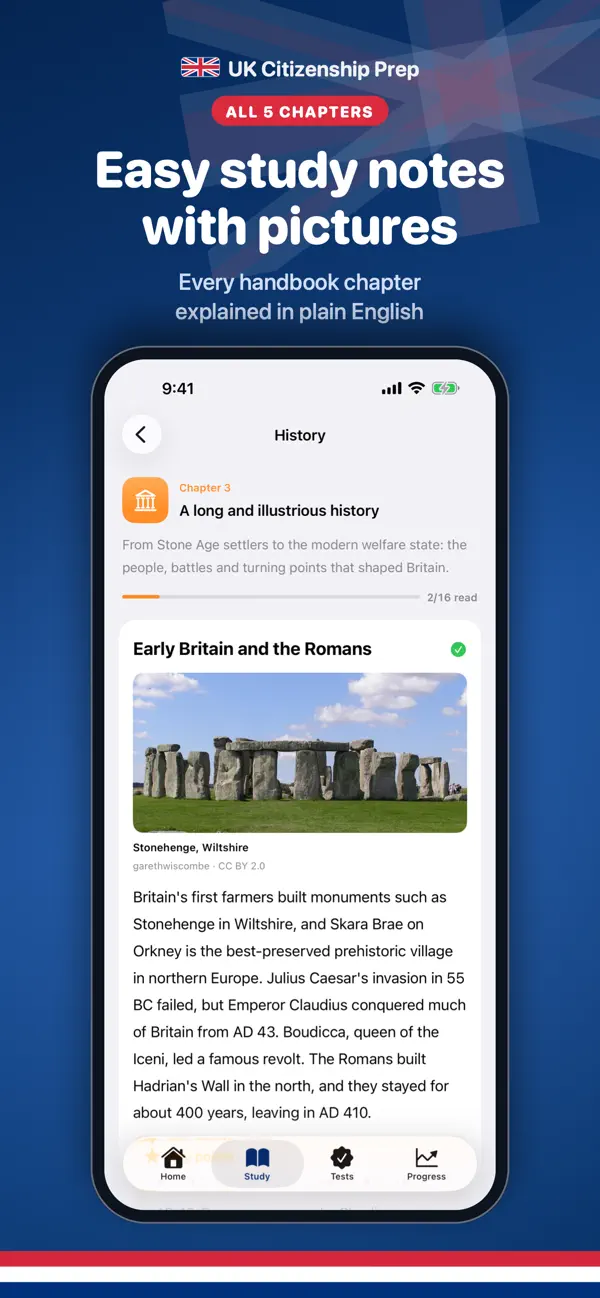
- 46 study note sections written from the official handbook.
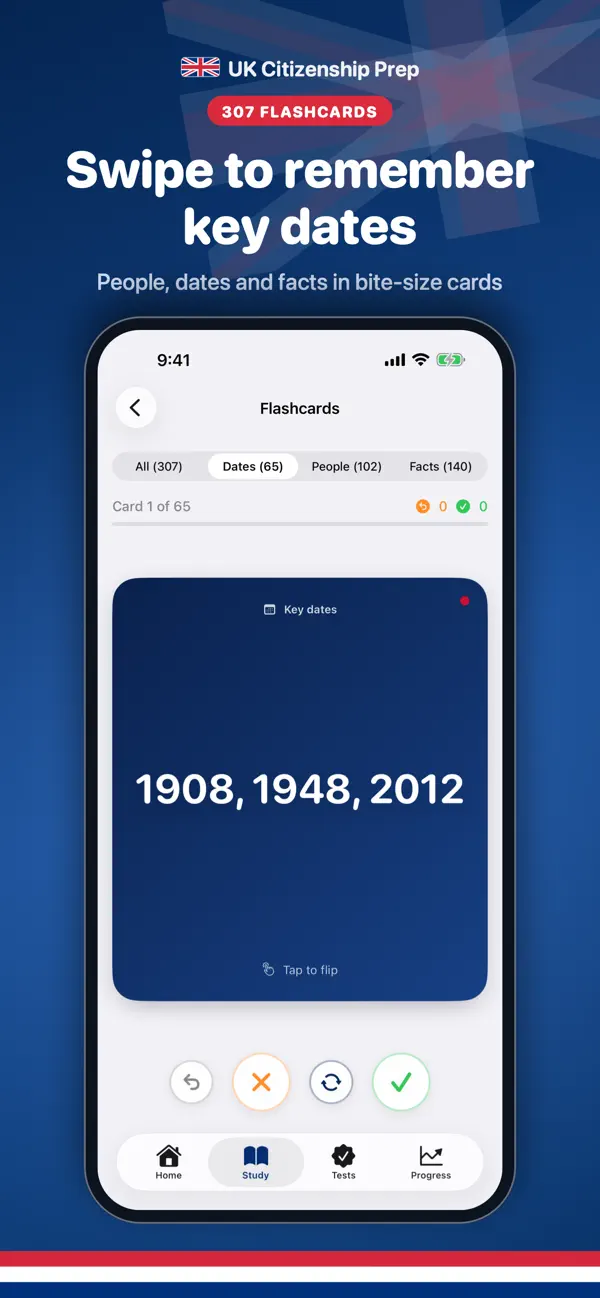
- 307 flashcards for the dates, people and facts that need memorising.
- A realistic mock exam: 24 questions, a 45-minute timer and the 18-mark pass line.
- A weak-areas list, readiness score, streaks and progress by chapter.
- Works fully offline, with no account. Every feature is free; an optional purchase removes ads.
Download UK Test Prep free on the App Store and pass the Life in the UK test first time. UK Test Prep is independent and not affiliated with the UK Government or the Home Office.
Frequently asked questions
Who discovered penicillin?
Alexander Fleming, in 1928.
Who invented the television?
John Logie Baird developed television in the 1920s.
Who invented the World Wide Web?
Tim Berners-Lee.
Who invented the jet engine?
Frank Whittle.
Who discovered the structure of DNA?
Francis Crick and James Watson, in 1953.
Who is Scotland’s national poet?
Robert Burns, who wrote Auld Lang Syne.
Who designed St Paul’s Cathedral?
Sir Christopher Wren.
Who wrote Pride and Prejudice?
Jane Austen.
Who was the first woman Prime Minister?
Margaret Thatcher, from 1979.
Who ran the first four-minute mile?
Sir Roger Bannister, in 1954.
Who was the first Briton to win the Tour de France?
Bradley Wiggins, in 2012.
How do I remember famous people for the test?
Learn names with achievements in pairs, group them by field, and review flashcards daily. UK Test Prep has 307 flashcards for dates, people and facts.
UK Test PrepDownload free