 RoadTick guide
UK Stopping Distances for the Theory Test: Chart, Car Lengths and an Easy Way to Remember
By Muhammad Shahid Khan · · 5 min read
Quick answer
In good conditions the Highway Code stopping distances for a car are 12 m at 20 mph, 23 m at 30 mph, 36 m at 40 mph, 53 m at 50 mph, 73 m at 60 mph and 96 m at 70 mph. Each is thinking distance plus braking distance. Stopping distances can be twice as long on wet roads and up to ten times as long on ice.
RoadTickHazard Perception & Mock Tests · Free on the App StoreDownload free →| 30 mph | 23 m (about 6 car lengths) |
|---|---|
| 70 mph | 96 m (about 24 car lengths) |
| Made up of | Thinking distance + braking distance |
| Wet roads | Up to twice as long |
| Icy roads | Up to ten times as long |
| Following gap | At least 2 seconds, doubled in the wet |
Stopping distances come up in almost every theory test, usually as "What is the shortest overall stopping distance at 40 mph?" They are easy marks once you know the numbers, and they are worth understanding properly because they explain why speed limits and following gaps are set where they are.
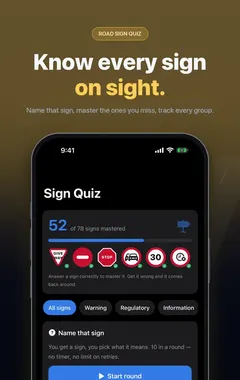
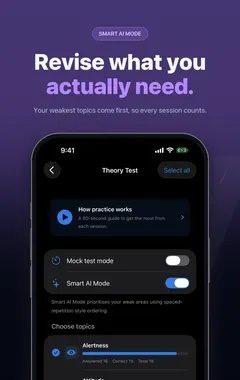
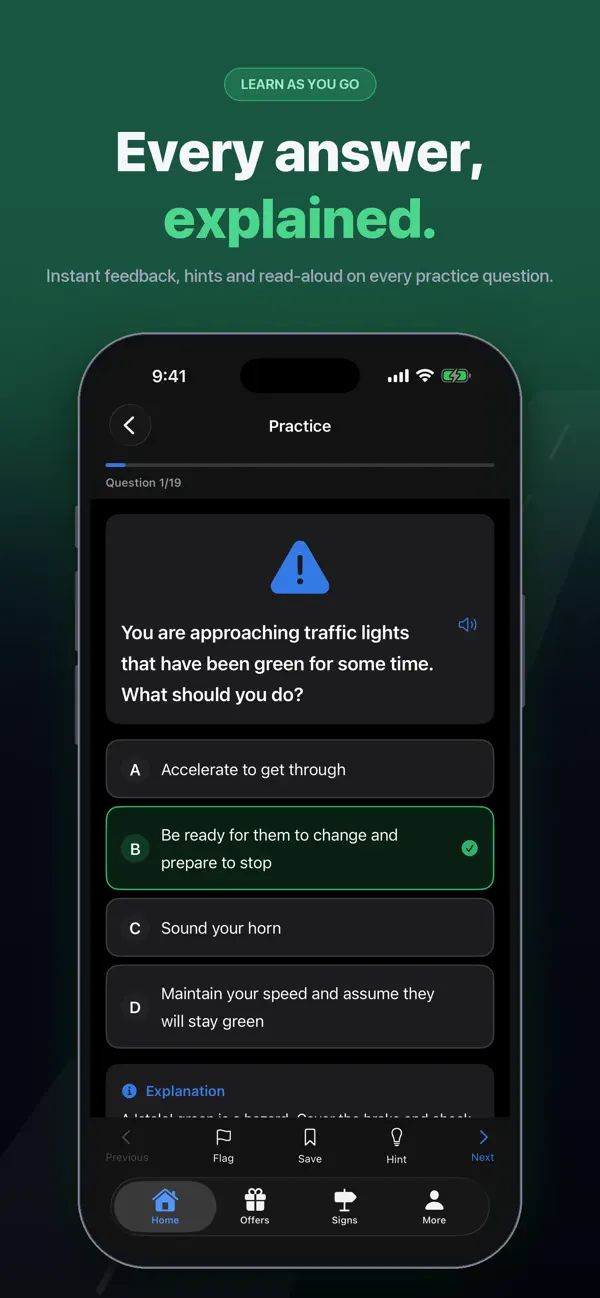
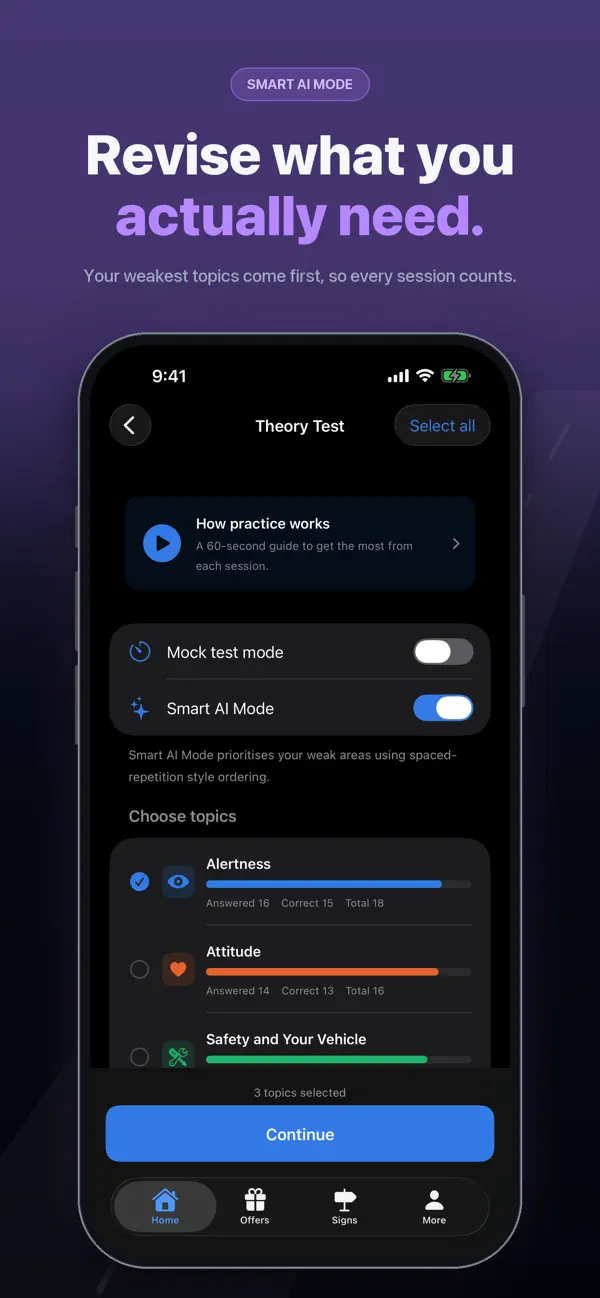
I build RoadTick: Driving Theory Test, a free UK theory test app for iPhone and iPad, and the screenshots in this guide come from it. If you want to practise as you read, get RoadTick on the App Store.
What are the UK stopping distances?
These are the typical stopping distances for a car in good conditions, from the Highway Code:
| Speed | Thinking | Braking | Overall | Car lengths |
|---|---|---|---|---|
| 20 mph | 6 m | 6 m | 12 m (40 ft) | 3 |
| 30 mph | 9 m | 14 m | 23 m (75 ft) | 6 |
| 40 mph | 12 m | 24 m | 36 m (118 ft) | 9 |
| 50 mph | 15 m | 38 m | 53 m (175 ft) | 13 |
| 60 mph | 18 m | 55 m | 73 m (240 ft) | 18 |
| 70 mph | 21 m | 75 m | 96 m (315 ft) | 24 |
The car lengths assume an average car of about 4 metres.
What is the difference between thinking and braking distance?
- Thinking distance is how far you travel between seeing a hazard and pressing the brake. It grows in a straight line with speed: 3 m for every 10 mph.
- Braking distance is how far you travel once the brakes are on. It grows much faster: doubling your speed roughly quadruples it. That is why going from 30 to 60 mph more than triples the overall distance.
Thinking distance gets longer if you are tired, distracted, ill, or have taken alcohol or drugs. Braking distance gets longer on wet, icy or loose surfaces, going downhill, with worn tyres or brakes, or with a heavy load.
How do I remember stopping distances?
Two tricks make the table easy:
- Thinking distance: take the first digit of the speed and multiply by 3. 30 mph gives 9 m, 70 mph gives 21 m.
- Overall distance in feet: multiply the speed by 2, 2.5, 3, 3.5, 4 and 4.5 for 20 to 70 mph. 30 × 2.5 = 75 ft, 70 × 4.5 = 315 ft. Then convert using the table if the question asks for metres.
For the theory test itself, most people simply memorise the overall column in metres: 12, 23, 36, 53, 73, 96.
How much longer are stopping distances in rain and ice?
| Conditions | Stopping distance | At 70 mph |
|---|---|---|
| Dry | As in the table | 96 m |
| Wet | Up to 2 times longer | Up to about 192 m |
| Icy | Up to 10 times longer | Up to about 960 m |
In fog, keep a gap that lets you stop within the distance you can see clearly.
How big a gap should I leave?
The Highway Code says leave at least a two-second gap behind the vehicle in front on roads with faster traffic, and at least four seconds on wet roads. Pick a fixed point, such as a lamp post. When the car ahead passes it, say "Only a fool breaks the two-second rule". If you reach the point before you finish, you are too close. In ice and snow the gap may need to be up to ten times greater.

Which stopping distance questions appear in the theory test?
- The overall stopping distance at a given speed, usually 30, 40, 50 or 70 mph.
- How much longer stopping distances are on wet or icy roads.
- The two-second rule and how it changes in the wet.
- What increases thinking distance (tiredness, alcohol, distraction).
More of the numbers the test likes are in how to revise the Highway Code, and how to use mocks to lock them in is in driving theory mock test strategy.
How RoadTick helps
- Practice questions for every theory topic, each with a plain-English explanation.
- Timed mock tests in the real format: 50 questions in 57 minutes, scored against the pass mark of 43.
- Hazard perception practice to build the timing the second part tests.
- The Highway Code broken into short sections that are easy to revise.
- UK road signs and markings with clear images and meanings.
- Progress tracking that shows which topics still need work before you book.
Download RoadTick free on the App Store and turn spare minutes into theory test practice. RoadTick is an independent app and is not affiliated with the DVSA.
Frequently asked questions
What is the stopping distance at 30 mph?
23 metres in good conditions: 9 m thinking and 14 m braking, about 6 car lengths.
What is the stopping distance at 70 mph?
96 metres in good conditions: 21 m thinking and 75 m braking, about 24 car lengths.
What is the stopping distance at 40 mph?
36 metres: 12 m thinking and 24 m braking.
What is the stopping distance at 50 mph?
53 metres: 15 m thinking and 38 m braking.
What is the stopping distance at 60 mph?
73 metres: 18 m thinking and 55 m braking.
How much longer is stopping distance in the wet?
Up to twice as long as in dry conditions.
How much longer is stopping distance on ice?
Up to ten times as long as in dry conditions.
What is the two-second rule?
Leave at least two seconds between you and the vehicle in front. Double it to four seconds on wet roads.
What is thinking distance?
The distance travelled between seeing a hazard and starting to brake. It is about 3 m for every 10 mph.
What increases thinking distance?
Tiredness, distraction, illness, alcohol and drugs all slow your reactions.
Why does braking distance increase so much with speed?
Braking distance grows roughly with the square of speed, so doubling your speed about quadruples it.
Does RoadTick have stopping distance questions?
Yes. RoadTick covers stopping distances in its safety margins questions, with an explanation for every answer.
RoadTickDownload free