 RoadTick guide
UK Road Markings Explained: White Lines, Yellow Lines, Zigzags and Cat’s Eyes
By Muhammad Shahid Khan · · 5 min read
Quick answer
UK road markings follow a simple rule: the more paint, the stricter the rule. Broken white lines are warnings or lane markers; solid white lines must not be crossed. Double yellow lines mean no waiting at any time, single yellow means no waiting at the times on nearby signs, and zigzags at crossings mean no stopping or parking. Red routes ban stopping altogether.
RoadTickHazard Perception & Mock Tests · Free on the App StoreDownload free →| Solid white centre line on your side | Do not cross or straddle |
|---|---|
| Double yellow | No waiting at any time |
| Single yellow | No waiting at times on the sign |
| Zigzags at a crossing | No stopping, parking or overtaking the lead vehicle |
| Double red | No stopping at any time |
| Cat’s eyes | White lanes, red left edge, amber right edge, green slip roads |
Road markings appear in many theory test questions, often as pictures. They are also easy to misread when you are actually driving. The good news is that they follow patterns. Learn the pattern, and most markings explain themselves.
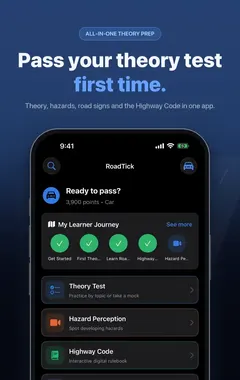
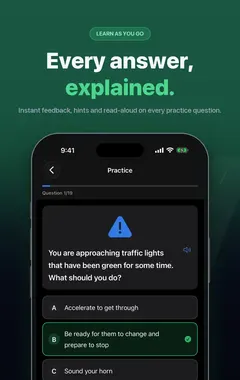
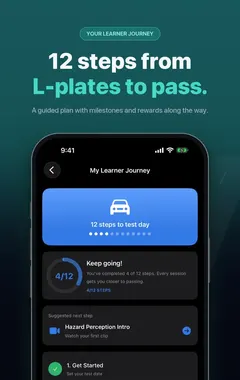
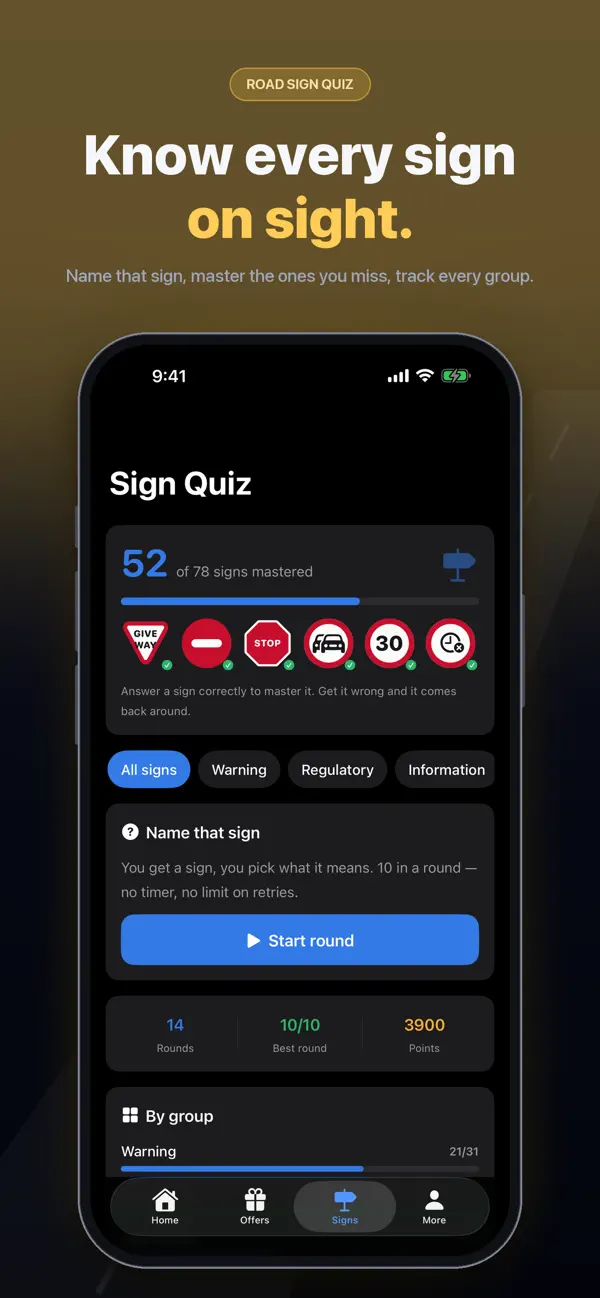
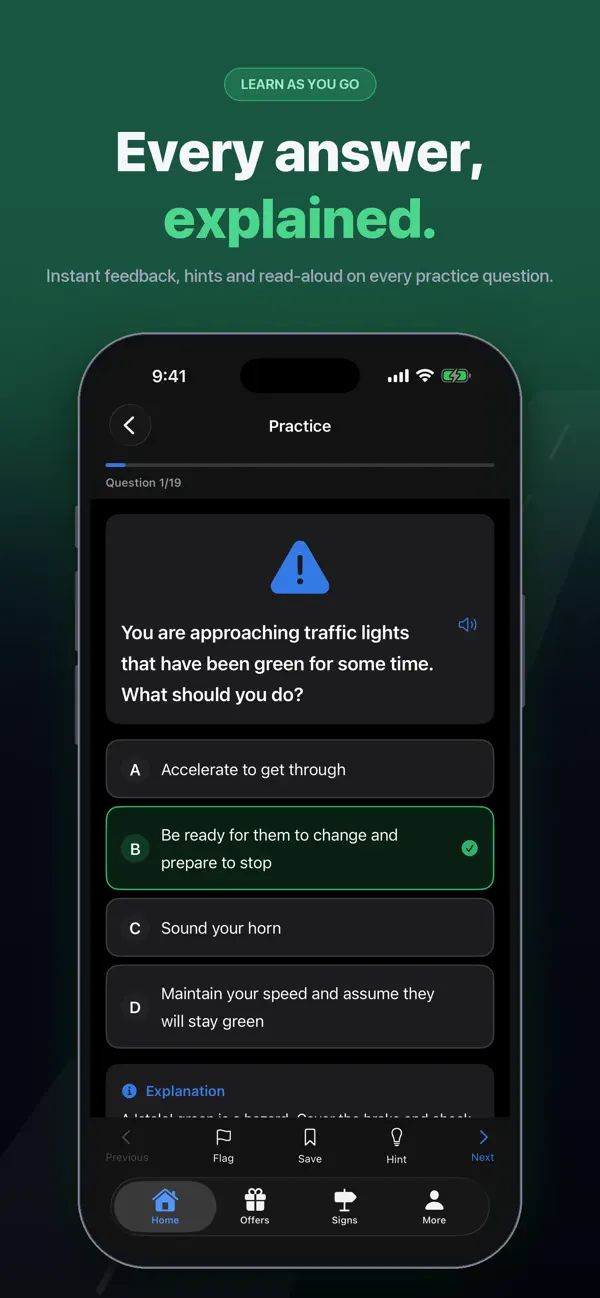
I build RoadTick: Driving Theory Test, a free UK theory test app for iPhone and iPad, and the screenshots in this guide come from it. If you want to practise as you read, get RoadTick on the App Store.
What do lines across the road mean?
| Marking | Meaning |
|---|---|
| Double broken white line | Give way to traffic on the major road or roundabout |
| Single solid white line | Stop line at traffic lights or a STOP sign |
| Advanced stop line (box for bikes) | Area for cyclists at lights. Stop at the first line |
What do white lines along the road mean?
- Short broken centre line: lane or centre marking. You may cross it when safe.
- Hazard warning line (long dashes, short gaps): a hazard ahead, such as a bend or junction. Do not cross unless you can see the road is clear well ahead.
- Double white lines with a solid line on your side: you must not cross or straddle it, except to pass a stationary vehicle, turn into a side road or property, or overtake a cyclist, horse rider or road maintenance vehicle going at 10 mph or less.
- Double white lines with a broken line on your side: you may cross to overtake if safe, and finish before a solid line on your side.
- Diagonal hatching: separates traffic. Avoid it if bordered by broken lines; do not enter it if bordered by solid lines, except in an emergency.
What do yellow and red lines mean?
| Marking | Meaning |
|---|---|
| Double yellow lines | No waiting at any time, unless signs show seasonal limits |
| Single yellow line | No waiting during the times shown on nearby plates |
| Double yellow marks on the kerb | No loading or unloading at any time |
| Single yellow mark on the kerb | Loading restrictions at the times shown |
| Double red lines | Red route: no stopping at any time |
| Single red line | Red route: no stopping during the times shown |
Blue Badge holders have some exemptions on yellow lines, but not on red routes or where loading bans apply.
What do zigzag lines mean?
- White zigzags at a pedestrian crossing: no stopping or parking, and you must not overtake the moving vehicle nearest the crossing, or a vehicle stopped to give way to pedestrians.
- Yellow zigzags with "SCHOOL KEEP CLEAR": do not stop or park during the times shown, even to drop children off.
What are box junctions, bus lanes and cycle lanes?
- Yellow box junction (criss-cross lines): do not enter unless your exit is clear. You may wait in it to turn right if you are only blocked by oncoming traffic.
- Bus lane (solid white line, "BUS LANE" painted): do not drive in it during its hours of operation, shown on the sign.
- Cycle lane with a solid white line: do not drive or park in it during its hours. Broken white line: do not drive or park in it unless unavoidable.
What do the colours of cat’s eyes mean?
| Colour | Where |
|---|---|
| White | Lane lines or the centre of the road |
| Red | Left edge of the carriageway |
| Amber | Right edge, next to the central reservation |
| Green | Edge of a slip road or lay-by you can cross |
| Green-yellow | Temporary changes, such as roadworks |
For the matching signs, see UK road signs explained, and for motorway lanes and signals, see UK motorway rules and signs.
How RoadTick helps
- Practice questions for every theory topic, each with a plain-English explanation.
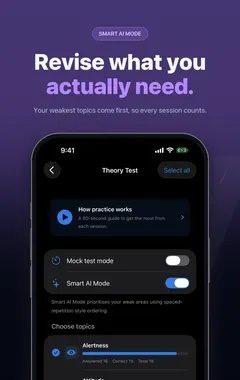
- Timed mock tests in the real format: 50 questions in 57 minutes, scored against the pass mark of 43.
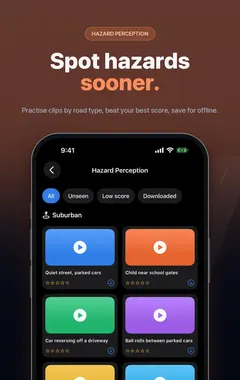
- Hazard perception practice to build the timing the second part tests.
- The Highway Code broken into short sections that are easy to revise.
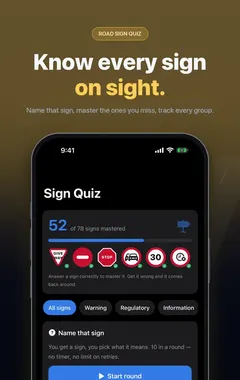
- UK road signs and markings with clear images and meanings.
- Progress tracking that shows which topics still need work before you book.
Download RoadTick free on the App Store and turn spare minutes into theory test practice. RoadTick is an independent app and is not affiliated with the DVSA.
Frequently asked questions
Can I cross a solid white line?
Not if the solid line is on your side, except to pass a stationary vehicle, turn off the road, or overtake a cyclist, horse rider or maintenance vehicle doing 10 mph or less.
What does a double broken white line across the road mean?
Give way to traffic on the major road or roundabout.
What do double yellow lines mean?
No waiting at any time, unless signs show seasonal restrictions.
What does a single yellow line mean?
No waiting during the times shown on nearby signs.
What do yellow marks on the kerb mean?
Loading restrictions. Double marks mean no loading at any time; single marks mean restrictions at the times shown.
What does a red route mean?
No stopping. Double red lines mean at any time; single red lines mean during the times shown.
Can I park on zigzag lines?
No. You must not stop or park on the zigzags at a pedestrian crossing.
Can I overtake on the zigzags at a crossing?
You must not overtake the moving vehicle nearest the crossing, or one stopped to let pedestrians cross.
When can I enter a yellow box junction?
Only when your exit is clear, or to wait to turn right when only oncoming traffic blocks you.
What colour cat’s eyes are on the left edge of the road?
Red. Amber marks the right edge by the central reservation, and white marks lanes.
What do green cat’s eyes mean?
The edge of a slip road or lay-by that you can cross.
Does RoadTick cover road markings?
Yes. RoadTick includes road markings with explanations, alongside the UK road signs library.
RoadTickDownload free